In this article
Bonita combines its own production at Bonita Farms with a network of producers and cooperatives across the Ecuadorian countryside. If you are a grower and want to sell your fruit under the Bonita brand, the first step is to write to us with your farm’s details: our team contacts you to talk through what comes next.
How does Bonita work with banana growers?
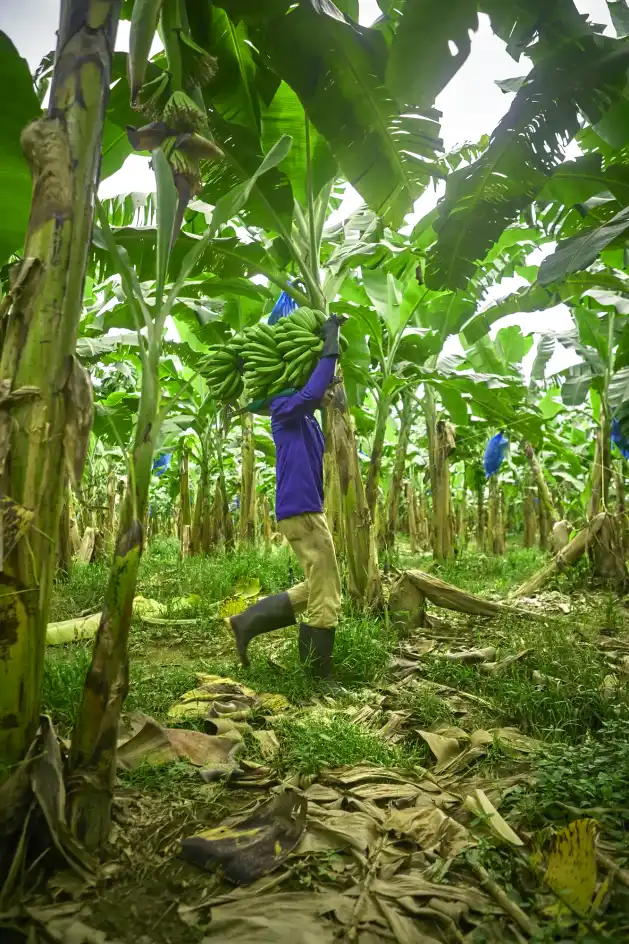
Bonita works with partner growers, small and medium-sized, and with cooperatives, to build long-term partnerships. Some are producers from El Oro who already sell their bananas under the Bonita brand. The idea is simple: we grow when the people who work with us grow.
That network sits alongside Bonita Farms’ own production, which covers 1,300 organic hectares. You can see how each piece fits in About us.
What should you have ready before contacting us?
Five things shape the conversation from day one.
1. Your plantation registered with the Ministry of Agriculture (MAGP). In Ecuador, anyone who owns, leases or holds farmland suitable for banana exports must register the plantation with the Ministry of Agriculture and Livestock. According to the ministry’s own manual, the application asks for the right form, a current RUC (tax ID), a certificate of liens and the property’s title history, proof of land rights if you are not the owner, and a georeferenced map. Growers who planted without prior authorisation can regularise their plantation until 31 December 2026, as the ministry has announced.
2. The minimum support price. Each year the State sets the minimum price an exporter must pay per box, calculated from the average cost of production plus a reasonable profit. For 2026 it is USD 7.50 per 43-pound 22XU box, valid from 1 January to 31 December, under the MAGP’s Ministerial Agreement no. 107. For the 15-pound boxes of orito (baby banana) and red bananas, the minimum is USD 5.26. In 2025 the 22XU minimum was USD 7.25, according to FAO. Knowing it lets you judge any offer with confidence.
3. Authorisation for new plantings. If you plan to expand your area, bear in mind that in Ecuador new banana plantations for export cannot be planted without the ministry’s prior authorisation. It is worth checking before you invest.
4. A written contract. Ecuadorian regulations encourage growers and exporters to formalise their relationship through contracts. Before signing any contract, read it in full and ask about anything you do not understand.
5. Your certifications, if you have them. Many international buyers ask for certifications. Bonita communicates Organic, Global G.A.P. and Rainforest Alliance; if your farm holds any, say so, because it helps identify which markets your fruit could reach.
Which box types are exported from Ecuador?
Knowing the market helps you see what is in demand. According to Acorbanec, of the boxes exported between January and November 2025, 83.22% were the 22XU type, 11.18% the 208 type, 3.99% organic bananas and 1.56% baby bananas. Red bananas were just 0.06%.
Bonita keeps Bananas and Organic as its main line, and also offers baby bananas and plantains. So when you write to us, it is useful to say what kind of fruit you grow.
What details does the grower form ask for?
To get to know you, the contact form asks for:
- Your name and the name of your farm or cooperative.
- The province and canton.
- The hectares you cultivate.
- The type of production: conventional or organic.
- The certifications you hold today.
- A phone or WhatsApp number and an email address.
Having them to hand makes our first reply more useful.
What happens after you write to us?
The Bonita team receives your information and contacts you. In that first conversation we answer your questions and talk through the next steps.
Frequently asked questions from growers
Can I sell my fruit under the Bonita brand?
Yes. We work with partner growers in Ecuador. Leave us your details and we will contact you.
Do I have to be a large grower?
No. Bonita works with small and medium-sized growers and with banana cooperatives.
What if my farm is organic or already certified?
Say so on the form: it asks about the type of production, conventional or organic, and about the certifications you hold today. With that information our team can guide you better.
How much will I be paid?
The State sets the minimum support price, as explained above. Specific commercial terms are discussed when you get in touch.
If you are ready, write to us on the contact page. And if you want to understand where your fruit goes next, follow the journey of a box, from farm to port or read about our Sustainability.
Sources
- Ministry of Agriculture and Livestock of Ecuador, 2026 minimum support price for the banana box, Ministerial Agreement no. 107 (17 September 2025): agricultura.gob.ec.
- Ministry of Agriculture and Livestock of Ecuador, manual for applying to register banana, plantain and other musaceae plantations for export (Ministerial Agreement no. 103): agricultura.gob.ec.
- Agrolatam, “Ecuador inicia proceso obligatorio para ordenar las siembras bananeras no registradas” (5 December 2025), on the 31 December 2026 deadline: agrolatam.com.
- FAO, Banana Market Review 2025 (Rome, 2026), on the 2025 minimum price: openknowledge.fao.org.
- Acorbanec, exports from January to November 2025 by box type: acorbanec.com.
- Cantrelle, N. and Dawson, C., “The banana in Ecuador”, FruiTrop no. 274 (CIRAD, 2021), on the Banana Law, contracts and new plantations: fruitrop.com.